
Engineer’s Notes
Moonlight Desert: String Instruments and Songs Crossing the Silk Road
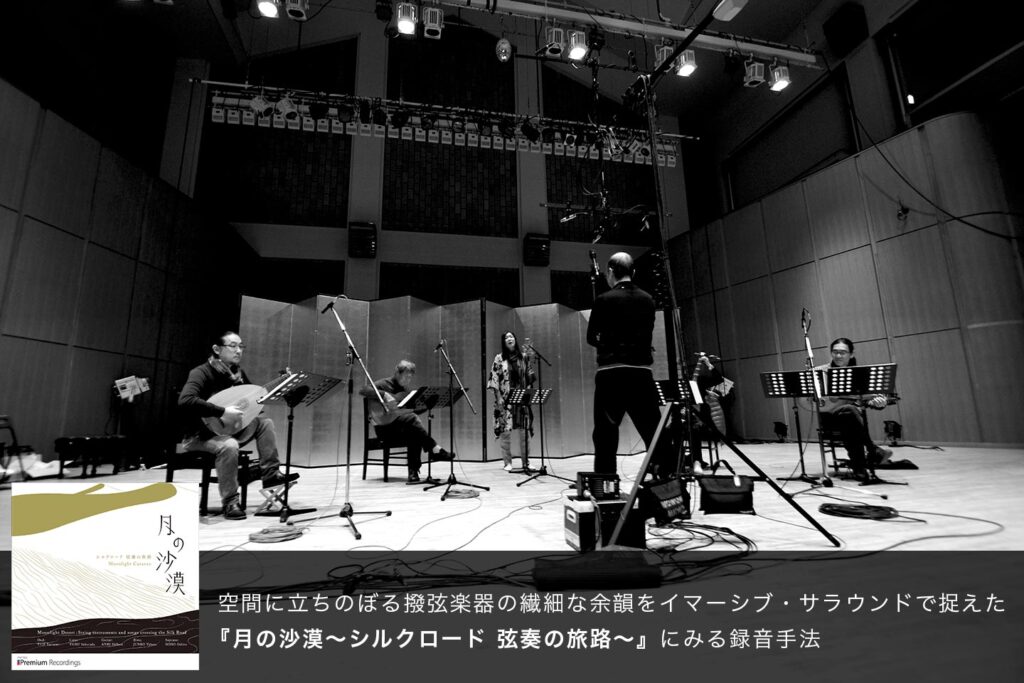
Recording Techniques Used in Moonlight Desert: String Instruments and Songs Crossing the Silk Road—Using Immersive Surround Sound to Capture the Subtle Reverberations of Plucked Strings as They Rise Through Space
Gathered at Chichibu Muse Park Music Hall with its reverberation-rich stone, Moonlight Caravan is a one-of-a-kind ensemble bringing together oud, lute, guitar, biwa, and soprano. In order to accurately capture the reverberations of the plucked strings, which are quiet by nature, engineer Hideo Irimajiri conducted a thorough inspection of the hall prior to recording. The positions of the performers and the placement of the microphones were meticulously planned, and the recording was done in 13-channel immersive surround sound (Auro 13.1 format; no LFE). The key to creating a recording that captured even the movement of the air was the configuration of a total of 16 microphones, including a “Double Decca Tree.” But what does this microphone array, resembling a single towering tree, achieve? We invite you to read our on-location report to find out.
Recording Engineer: Hideo Irimajiri

Born in 1956. Graduated from the Kyushu Institute of Design in 1979 with a degree in acoustic design, and again in 1981 with a master’s degree from the same institute. He was awarded a Ph.D. in Art and Engineering in 2013 for his research on reverberation. In 1981, he joined Mainichi Broadcasting System, Inc. He worked in the video technology, audio technology, hall technology and postproduction, and mastering departments before being seconded to WOWOW Inc. in 2017. In 1987, he was involved in the broadcasting industry’s first surround sound broadcast of high school baseball. Since 2005, he has researched loudness issues in broadcasting and has also worked towards standardization as a member of ARIB and The Japan Commercial Broadcasters Association. He began recording as a student, exploring 4-channel recording and spatial acoustics in particular. He is currently developing 3D audio recording technology and is actively involved in its production and promotion. He also pursues personal recording projects under the name Jiro Iruma and has composed pieces such as the opening theme for the Hanazono National High School Rugby Tournament and the music for the PC game Record of Lodoss War.
Recording Techniques Used in Moonlight Desert: String Instruments and Songs Crossing the Silk Road
Recording date and location: October 19-20, 2017, Chichibu Muse Park Music Hall
Recording format: PCM 192kHz/24-bit
Microphone Placement
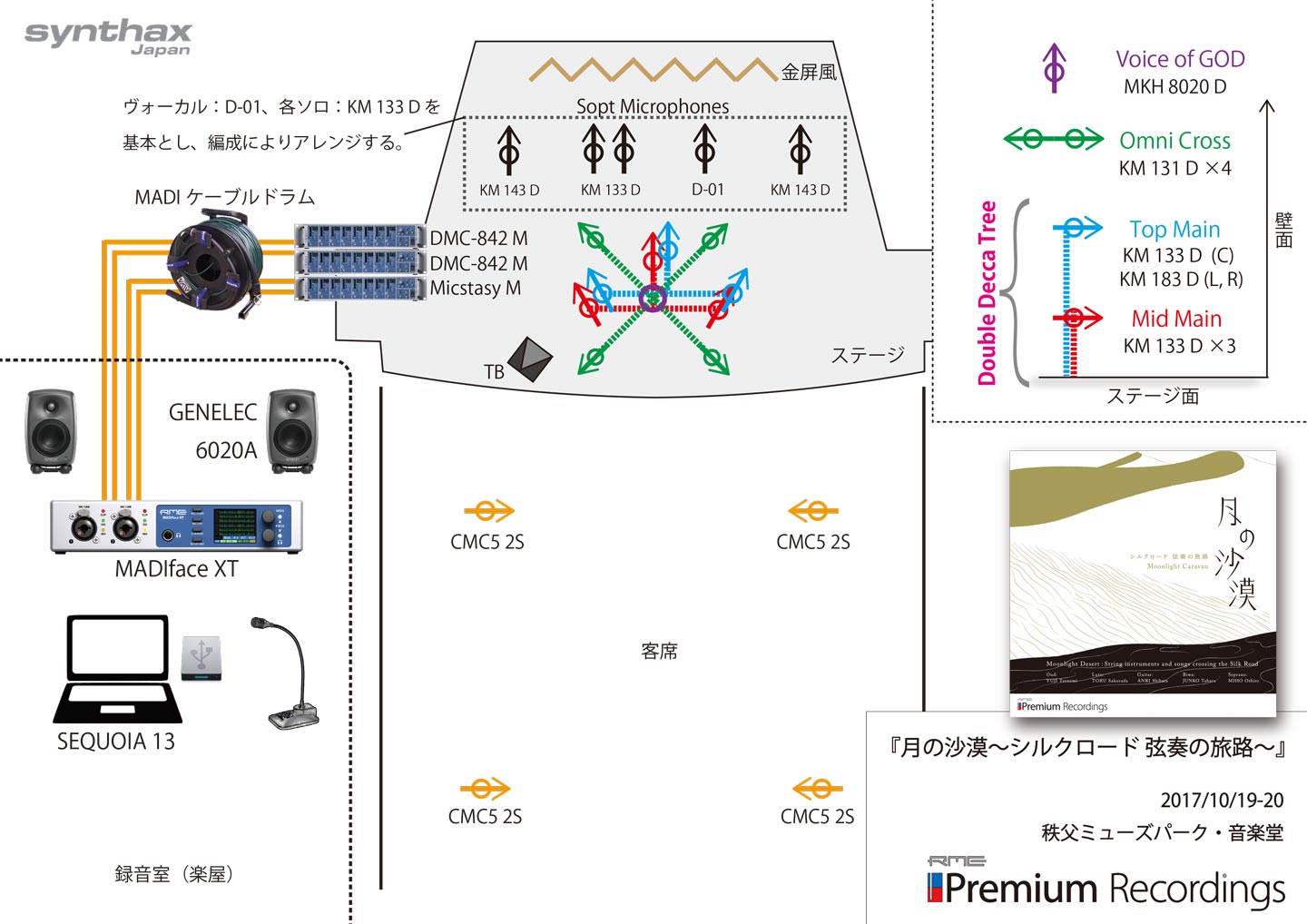
For this recording, a thorough inspection of the hall was carried out in advance. Irimajiri walked through the hall, clapping his hands as if striking a pair of wooden clappers, first determining the area with the best acoustics and selecting that as the performance space. Next, still clapping his hands, he decided on the microphone placement. The diagram above shows the layout used for this performance, with the gold folding screen shown installed not as decoration but as reflective paneling. During the inspection, Irimajiri felt that the sound tended to disperse, and the screen’s use was decided on as soon as the inspection was over. It seems that the gold leaf surfaces of the screen also contributed to the reflection of sound. Seeing Irimajiri grasp the acoustics of the space with a single clap of his hands, one cannot help but be amazed at the engineer’s exceptional skill.
Main Microphone:
Top Main:KM 183 D(L, R)、KM 133 D(C)
Mid Main:KM 133 D ×3
Double Decca Tree
The main microphone used in this recording was the “Double Decca Tree.” A Decca Tree is a stereo recording technique originally developed by British record label Decca Records, and uses three omnidirectional microphones arranged in a left-center-right formation. In this setup, two Decca Trees (Top and Mid) were stacked vertically. The Top array was assigned to the Auro 13.1 Top and Height Layers (HL, HC, HR), and the Mid array to the 7.1 Surround Layer (L, C, R).
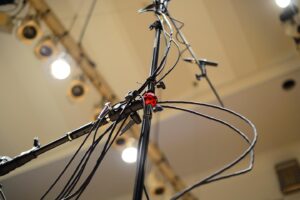
The microphone bar, formed of two Decca Tree layers (Top and Mid) and resembling a towering tree, is an original design by Irimajiri, built by combining a variety of components.
Omni Cross
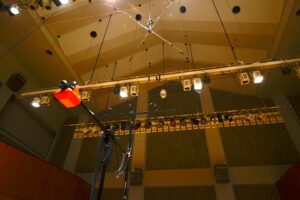
Suspended from the lighting bar was the 1.5 meter square “Omni Cross,” a microphone arrangement created by Irimajiri. As its name suggests, it employs four omnidirectional KM 131 D microphones, with their positions finely adjusted using ropework. These microphones were assigned to the Auro 13.1 Top and Height Layers’ HL, HR, HLS, and HRS channels.
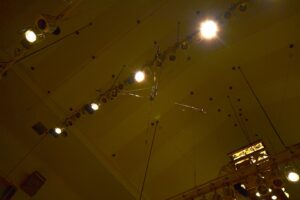
In addition, about three meters above the Omni Cross was an MKH 8020 D microphone dedicated to the “Voice of God” channel, responsible for the top speaker in the Auro 13.1 Top and Height Layer.
Spot Microphones:
D-01
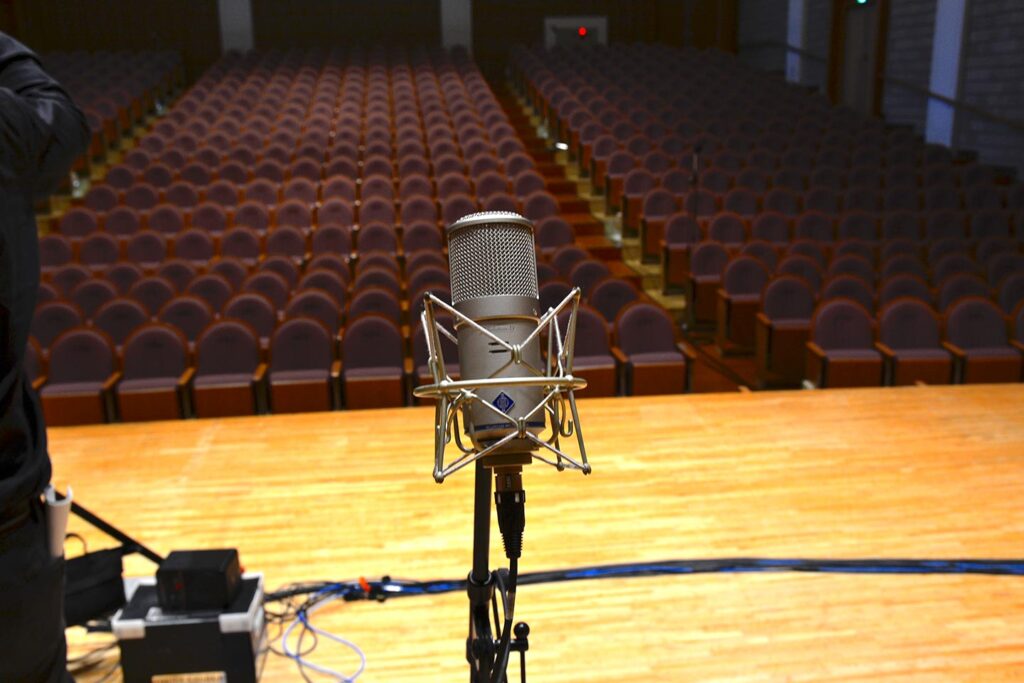
Primarily used for vocals, Neumann’s flagship digital microphone, the D-01, features adjustable directional patterns. For this recording, it was used in omnidirectional mode, and proved highly effective when recording The Tale of the Heike (biwa narrative singing).
KM 133 D x2
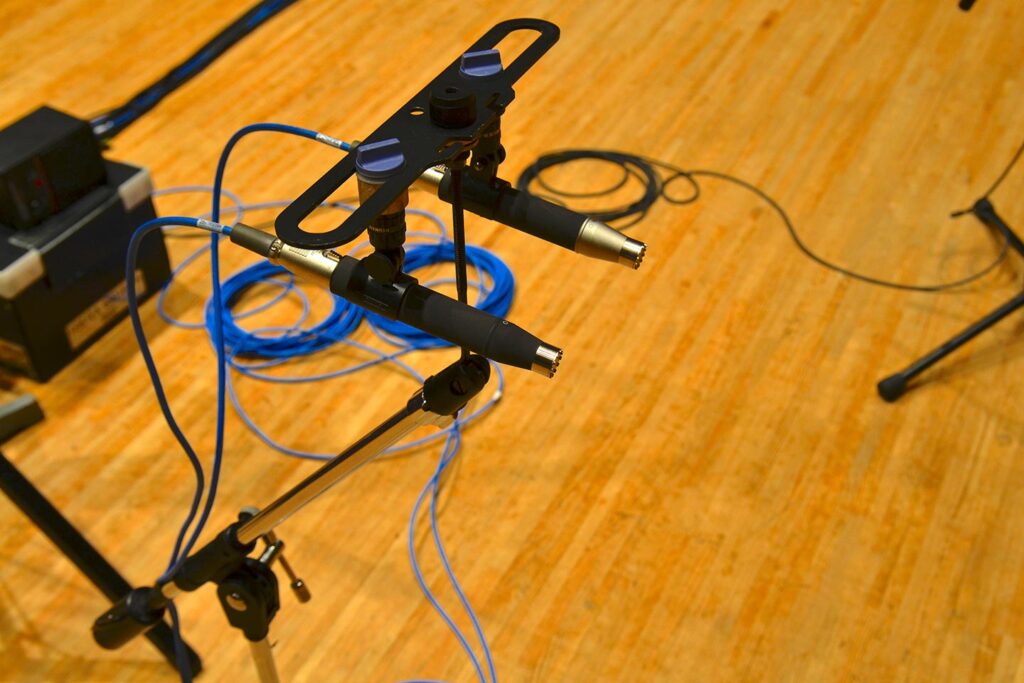
For solo instruments, a pair of KM 133 D microphones, shared with the main setup, was used. The different colors of the capsule sections were used to differentiate between the left and right channels.
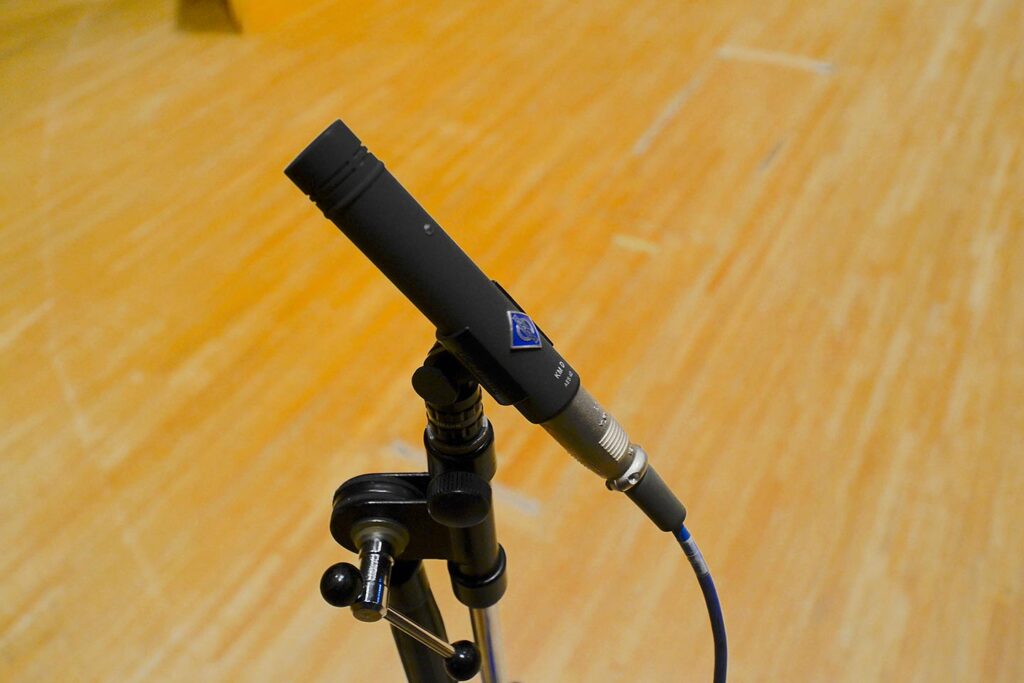
KM 143 D
Used in a wide range of situations, including ensemble sections.
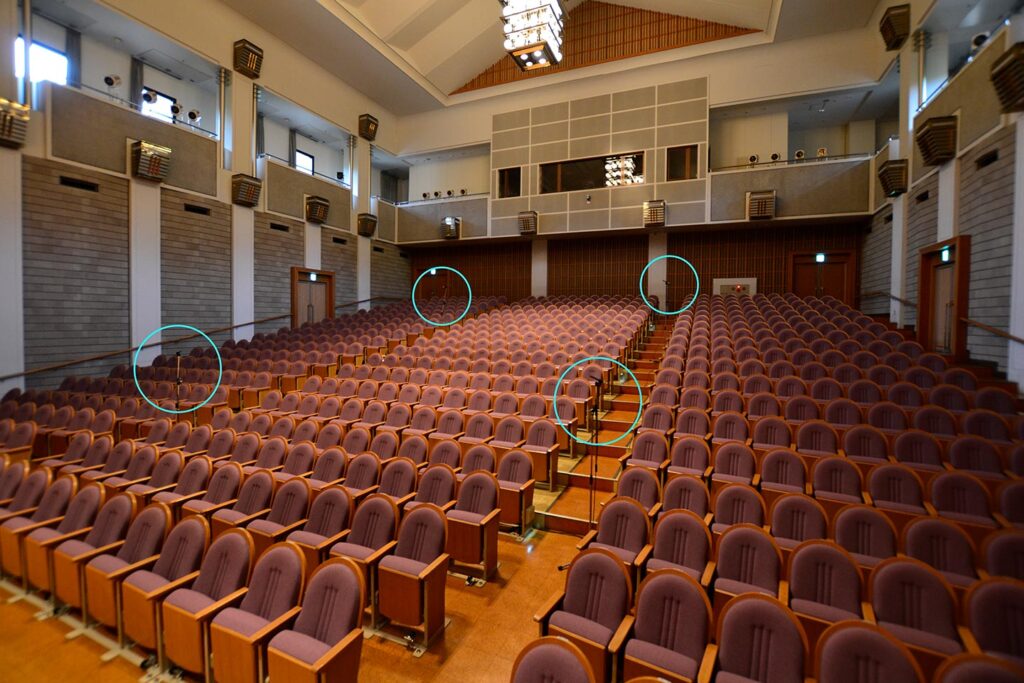
These were the only analog microphones used in this recording. In the world of immersive sound recording, the concepts of “object reality” and “field reality” are often used, with different recording methods employed to capture each. For this recording, the “Double Decca Tree” was used to capture “object reality” (the sound of the instruments themselves), while the four microphones in the audience seating area were dedicated to “field reality.”
Mic Preamps: RME DMC-842 M/Micstasy M

The microphone preamplifiers installed at the side of the stage consisted, as shown in the photo from top to bottom, of two RME DMC-842 M units and a Micstasy M unit. Connected to this setup were the 16 digital microphones on the stage, the four analog microphones positioned in the audience seating area, and an AMBEO VR MIC used to conduct experimental recording, for a total of 24 channels. The system was connected to a MADIface XT in the recording room (backstage) via MADI optical cables, minimizing the use of analog cables to reduce noise. This system is the ideal setup for recording plucked string instruments, which have inherently low sound levels.
Audio Interface: RME MADIface XT
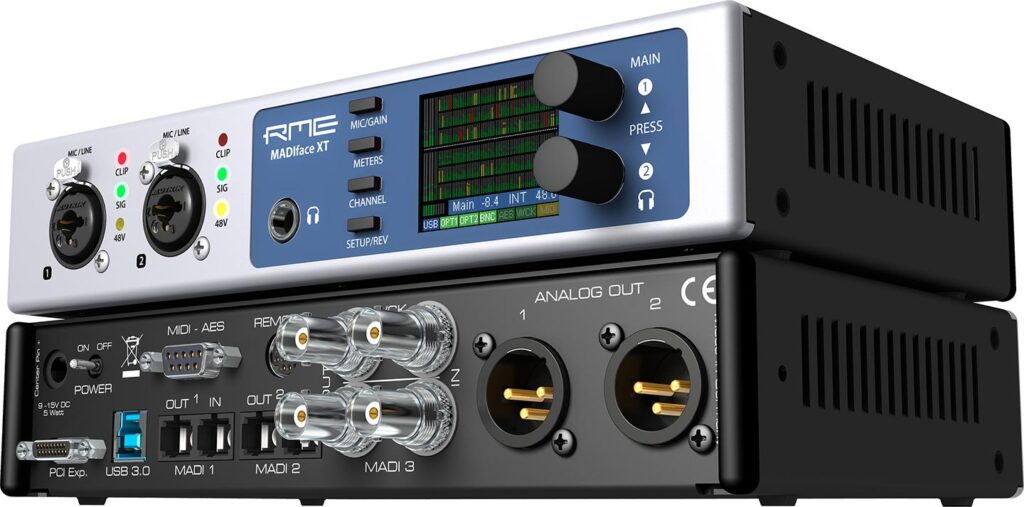
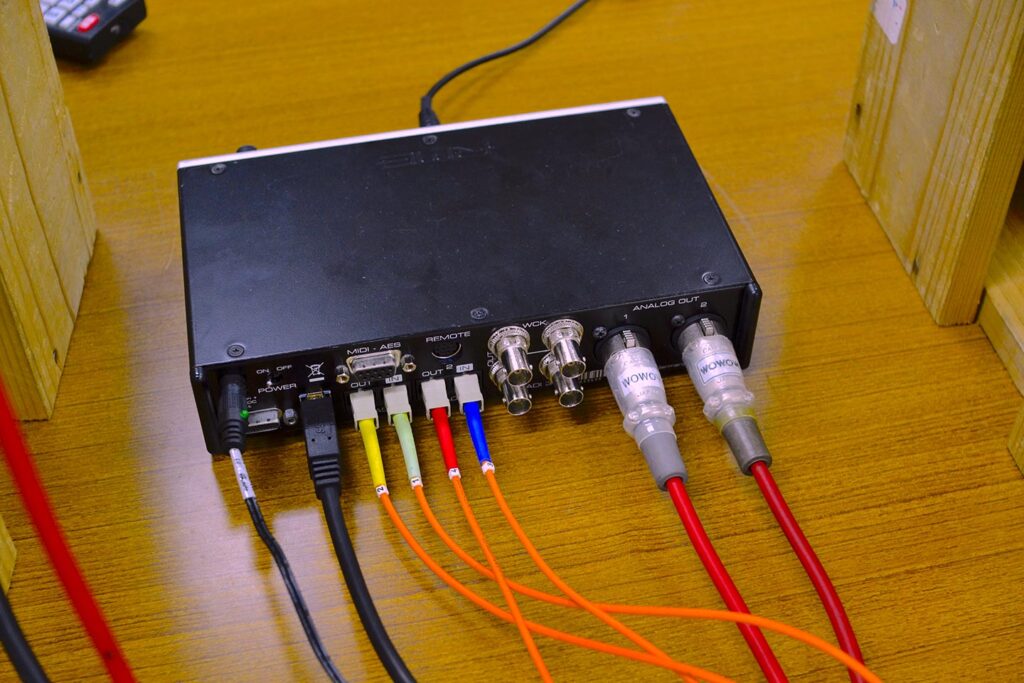
The RME MADIface XT was connected to the microphone preamp array next to the stage via MADI optical cables. The four orange cables shown here were consolidated into a single drum cable, allowing transmission of 24 channels at 192kHz/24-bit resolution.
DAW Software: MAGIX SEQUOIA 13
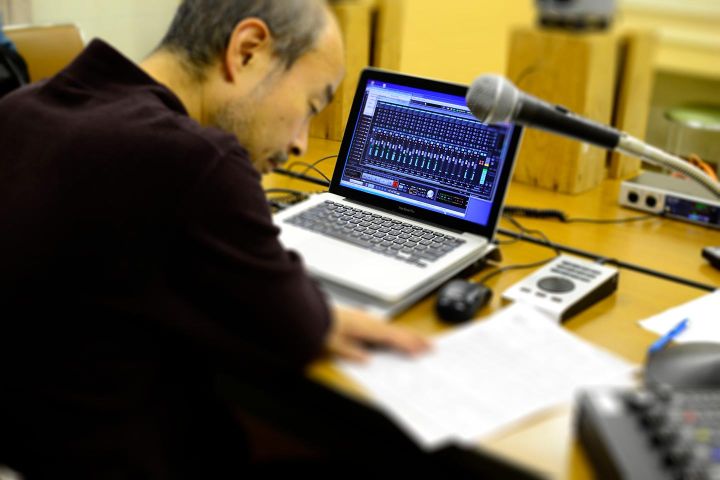
SEQUOIA’s audio quality is highly regarded for audio mastering, but its ability to work with significantly larger buffer sizes than other DAW software and the stability this affords make it extremely appealing for recording as well. In classical music recording environments in Germany, the combination of German brands RME and SEQUOIA is a common sight, with a defining characteristic being the wealth of features suited to editing classical music. This recording is also available in 5-channel surround sound and HPL13. We invite you to experience the essence of Auro 13.1 for yourself!
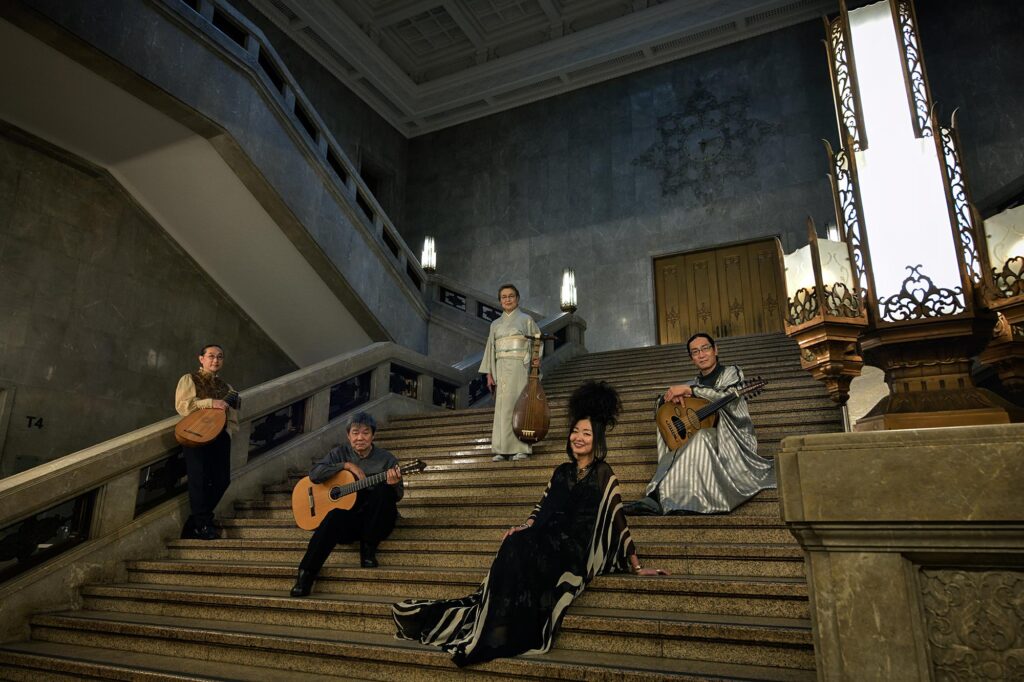
Moonlight Caravan
From left:
Toru Sakurada (lute)
Anri Shibata (guitar)
Junko Tahara (biwa)
Miho Oshiro (soprano)
Yuji Tsunemi (oud)
Yuji Tsunemi
Yuji Tsunemi is regarded as a pioneer and a leading oud performer not only in Japan but also throughout East Asia. He studied under the late Sudanese oud player Hamza El Din, and in 1989, he studied under the late Ali Sriti, a leading Tunisian oud player in the Arab world. After returning to Japan, he has pursued an active performance career. He continues to convey the charm of the oud while also contributing to the development of Japanese oud players and influencing various musical genres. In addition to live performances and concerts throughout Japan, he also frequently performs at embassies of various countries in Tokyo, and served as supervisor for Arab music for NHK’s The New Silk Road. He has written and recorded many songs, and his unique presence has been widely featured on television and radio. http://www.oud.jp/
Toru Sakurada
After graduating from the Japan Guitar School, he studied lute under Toyohiko Satoh at the Royal Conservatoire the Hague in the Netherlands. He plays a wide range of plucked instruments in the lute family, using each appropriately according to the era and the music being played. His performance style—using gut strings to draw out the historical expressiveness of pieces—is rare even overseas. As an accompanist, his flexibility in adapting to the situation at hand has earned him the trust of his many collaborators. His solo CDs include Yasuragi no Gut (Varietie of Lute Collections: Toru Sakurada – Favorite Lute Music, Anthology on seven all-gut-string lutes), Kōtei no Bieuera / Shimin no Lute (Narvaez s Newsidler: Toru Sakurada [Vihuela, Lute]) (recommended by Record Geijutsu magazine, quasi-special selection), Pachelbel: Koibito no Tameiki (Pachelbel: Sighs of a Lover) (same selection), and Teorubo no Ongaku (Theorbo) (same selection). His trio CD Music from the Netherlands, released in 2017 with Toyohiko Satoh and Miki Satoh, was chosen as a special selection by Record Geijutsu magazine. He serves as the Secretary General of the Lute and Early Guitar Society Japan. http://www.lutelute.com/
Anri Shibata (guitar)
(Guitar)
Graduated at the top of his class from the Madrid Royal Conservatory. While in Spain, he studied under Jorge Ariza, Narcisco Yepes, Sainz de la Maza, and José Luis González. He won first place at the 1978 Francisco Tárrega International Guitar Competition, and at the 1982 José Luis González International Guitar Competition. In November 1998, he was invited by the Brazilian government to serve as a judge at the 6th Villa-Lobos International Guitar Competition, where he also held a concert. He has released several solo albums—El Rastro, Para Su Novia, El Mestizo, and The Prince’s Toys, which have all become exceptionally long-selling classical CDs. A highly talented accompanist and arranger, he has arranged and accompanied a variety of ensembles, including strings, winds, and vocal works. He is renowned for his diverse repertoire, ranging from classical to contemporary music. His exceptional musicality and natural sense of rhythm captivate listeners, and he has a large fan base across generations.
Junko Tahara (biwa)
(Biwa)
A biwa player who enjoys performing concerts in small halls where she can engage in conversation with the audience. She performs not only traditional narrative works such as The Tale of the Heike, but also many contemporary and original narrative pieces, continually exploring biwa music to suit modern sensibilities. She studied the Chikuzen biwa under the late Mikiko Yamada and Yamazaki Kyokusui (a Living National Treasure). In 1982, she won first place in the Biwa Competition. She is a recipient of the Education Minister’s Encouragement Prize and the Japan Broadcasting Corporation Chairman’s Award. In addition to holding recitals and concerts around the world, she actively undertakes new creative projects, including premiering original works. As a member of Pro Musica Nipponia, she has performed not only in Japan but also around the world. She received the Ongaku no Tomo Sha Prize and the Remy Martin Music Award in 1979, the Matsuo Performing Arts Award in 1988, and the Mobile Music Award in 1990. In 2005, she released an 8-part CD series of The Tale of the Heike: Miyao’s Book. http://naks.biz/biwa-jun/
Miho Oshiro (soprano)
(Soprano)
Graduated from the Musashino Academia Musicae’s Vocal Course. After performing with a professional choir, she went freelance. In addition to numerous concert appearances at halls and music salons around the country, she has also participated in many performances for television, radio, CDs, film scores, and educational materials. She has performed as a soloist for works such as Beethoven’s Symphony No. 9 and Messiah, and performs songs from nine countries in their original languages. She has given eleven solo and guitar duo recitals in Tokyo. As part of the duo “UTAUD” with oud player Yuji Tsunemi, she pursues a crossover classical style that combines Arabic music and traditional Japanese folk songs, with her wide-ranging performances centering around ensembles. A lover of plucked string instruments, she has planned, hosted, and performed in the Moonlight Caravan Concert series since 2012. Her CDs include Yamato Shi Utsukushii (Beautiful Yamato), España, and Tsuki ni Yosu (To the Moon). With her soothing, silky voice and her striking stage presence owing to her 172cm height, she continues to captivate fans. http://www.oshiromiho.com/
